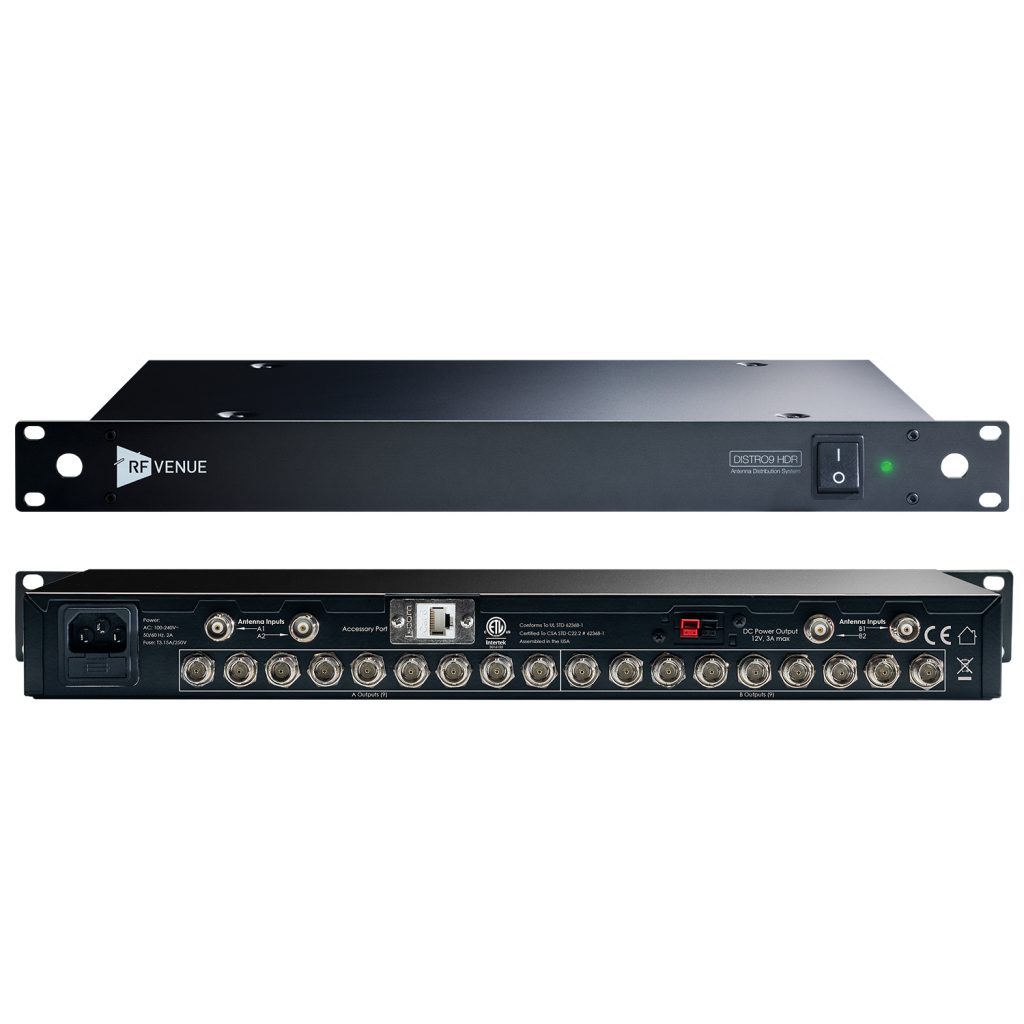
RF Venue, the global leader in antennas, spectrum analysis and RF signal management tools for the professional audio-visual industry, has announced the immediate availability of its much-anticipated DISTRO9 HDR antenna distribution system, designed to provide system integrators and end users with a powerful new tool for configuring multi-channel wireless microphone systems.

DISTRO9 HDR’s proprietary architecture can connect up to 9 wireless microphone receivers with two zones of antenna coverage built-in. With superior gain flatness and high dynamic range across VHF, T-Band, and UHF, the DISTRO9 HDR comes ready for multi-band wireless microphone operation in a compact 1RU footprint.

Any of its clean, low-noise diversity outputs can be cascaded to another DISTRO9 HDR, for up to 17 channels of wireless microphones in just 2RU of rackspace. Multi-zone installations are easy with the DISTRO9 HDR’s two zone antenna inputs, providing coverage for large areas or multiple rooms, each with switchable DC power available for in-line amplifiers or active antennas.

Featuring a robust internal power supply, the DISTRO9 HDR can provide clean DC power to wireless microphone receivers with an optional DC cable kit, and can also be powered directly from a DC battery source for location sound cart applications.

The DISTRO9 HDR is also ETL listed to meet bid specification requirements on municipal, government, and other high profile projects. An internal I/O section provides a range of future module add-on capabilities ranging from remote web-based spectrum monitoring to bandpass filtering, and more. As RF spectrum congestion grows and operating bands evolve worldwide, the DISTRO9 HDR is highly configurable to meet the current and future needs of any professional wireless microphone system.

Company president Chris Regan commented, “the DISTRO9 HDR is a high performance antenna distribution system designed and built in the USA. This is a powerful new tool packed with the innovation, engineering, and quality RF Venue customers have come to expect. With more wireless devices competing for less available RF spectrum worldwide, the DISTRO9 HDR provides a flexible platform for wireless microphone users operating in a range of frequency bands and adverse RF spectrum conditions.”

RF Venue Multi-Zone Antenna Distribution System
Availability

JPRO is the authorised NZ Dsitributor for RF Venue. The DISTRO9 HDR is now in-stock to demo today. To learn more about what the DISTRO9 HDR can do for your next wireless project contact JPRO today.

As the UHF wireless microphone spectrum becomes more congested and regulation gets tighter around the frequency allocation, microphone manufacturers have started using the 2.4 GHz licence free spectrum to alleviate some of these pressures.

2.4 GHz microphones operate in 83 MHz of spectrum between 2.400 GHz and 2.483 GHz. By comparison, most wireless microphones today operate at lower “UHF” frequencies between 470 MHz and 698 MHz.

Let’s take a look at the pros and cons of wireless microphones that operate in the 2.4 GHz ISM band.

Pro’s

Simple to operate (under ideal conditions)

The selling points for most of these models are “easy,” “easy,” and “easy.” The predictable locations of WiFi channels allow 2.4 GHz mics to sniff out where occupied frequencies are and are not, and they are also great at communicating with other mics and self-coordinating (this is probably because 2.4 GHz microchips ship with more advanced radio protocols than off the shelf UHF chips).

2.4 GHz chips do not use FM modulation, and they are (at least the ones we’ve seen) all digital, so they are less susceptible to the intermodulation artifacts that plague multi-channel UHF FM systems. Mics from professional grade manufacturers like Shure, Sennheiser, AKG, Line6, and AT have tuned their modulation and circuitry to bring latency down to acceptable levels, as opposed to simply sending audio over WiFi.

International compliance

Properly manufactured 2.4 GHz microphones can be used in nearly every country without a license, in the same frequency range. UHF frequency bands are not synchronised across international borders, and the rules for wireless microphones vary from country to country. In some countries like the U.K. operating professional UHF equipment requires a permanent or temporary license, and half of the equipment sold in the UK in the 700 MHz band is illegal to use in the United States. 2.4 GHz mics give users a free pass from all the regulatory confusion.

Price

Smaller wavelengths mean smaller antennas and electronic components, which means that manufacturers can pack more features into a 2.4 than a UHF at the same price point.

Cons

Channel count

Manufacturers are careful to state their 2.4 GHz offerings are channel limited. The EW-D1 footnotes up to eight channels “in an ideal RF environment” (some press releases state 15 channels. I don’t know which spec is correct). The AKG DMS100 specifies “up to four channels” per receiver and the AKG DMS300 offers “up to eight channels” per receiver.

2.4 GHz mics aren’t able to offer as many channels because 2.4 GHz chips operate on less spectrum, ~83 MHz, compared with available manufacturer specific blocks/bands adding up to ~230 MHz in UHF. And because 2.4 GHz is so dang crowded with Bluetooth and WiFi thingamabobs, you rarely get all of that spectrum to yourself.

Range and in-line attenuation

Given the same transmission power, under the same conditions, a UHF microphone will provide greater range than a 2.4 GHz microphone. In our experience, many overestimate just how much range they actually need (if the stage is within 100’ of the performer, you should be OK), and 2.4 GHz microphones sometimes have more powerful transmitters to compensate for the loss (The DMS has a maximum output of 100 mW, 2X the max for unlicensed UHF). You can also use a directional antenna to significantly improve range, but remember that transmission line (cable) loss is much greater at 2.4 GHz than UHF, so long cable runs are difficult.

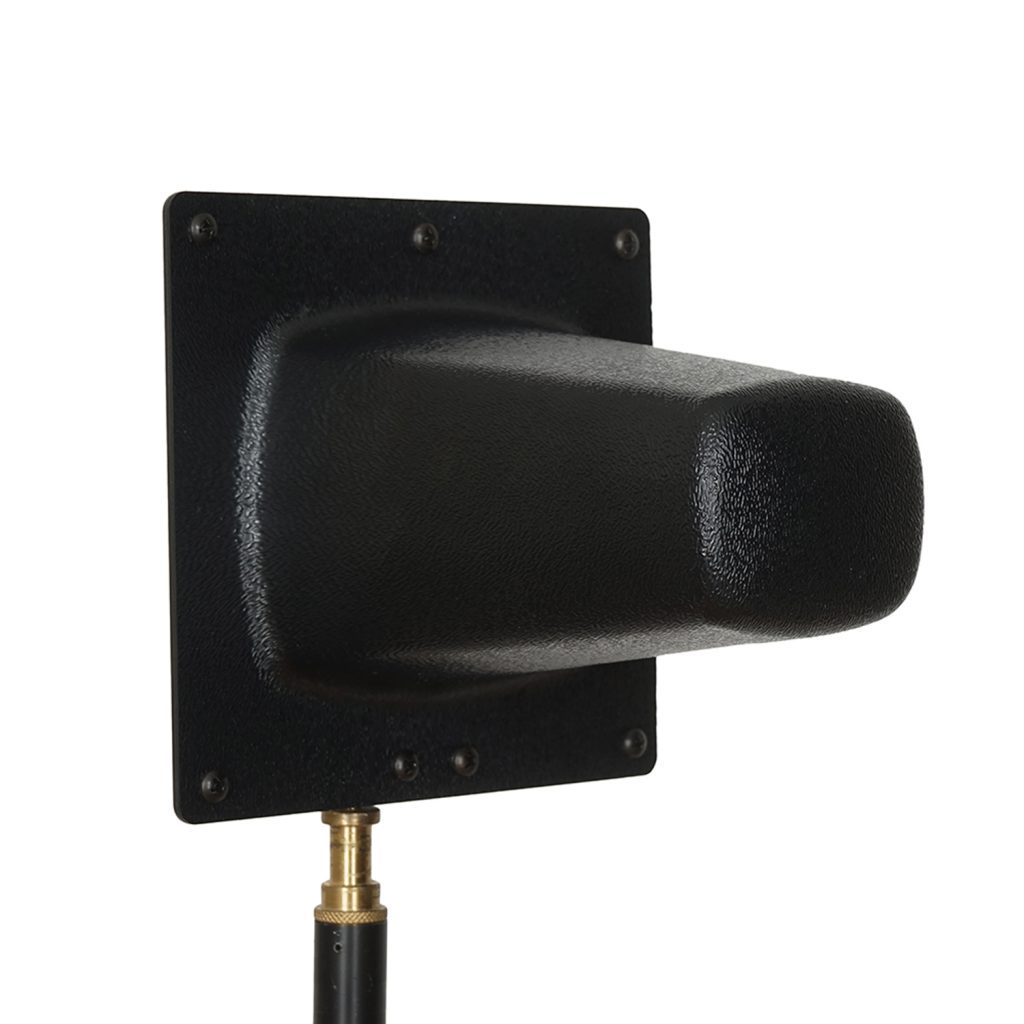
RF Venue 2.4GHz Antenna
High Performance 2.4 GHz Helical Antenna
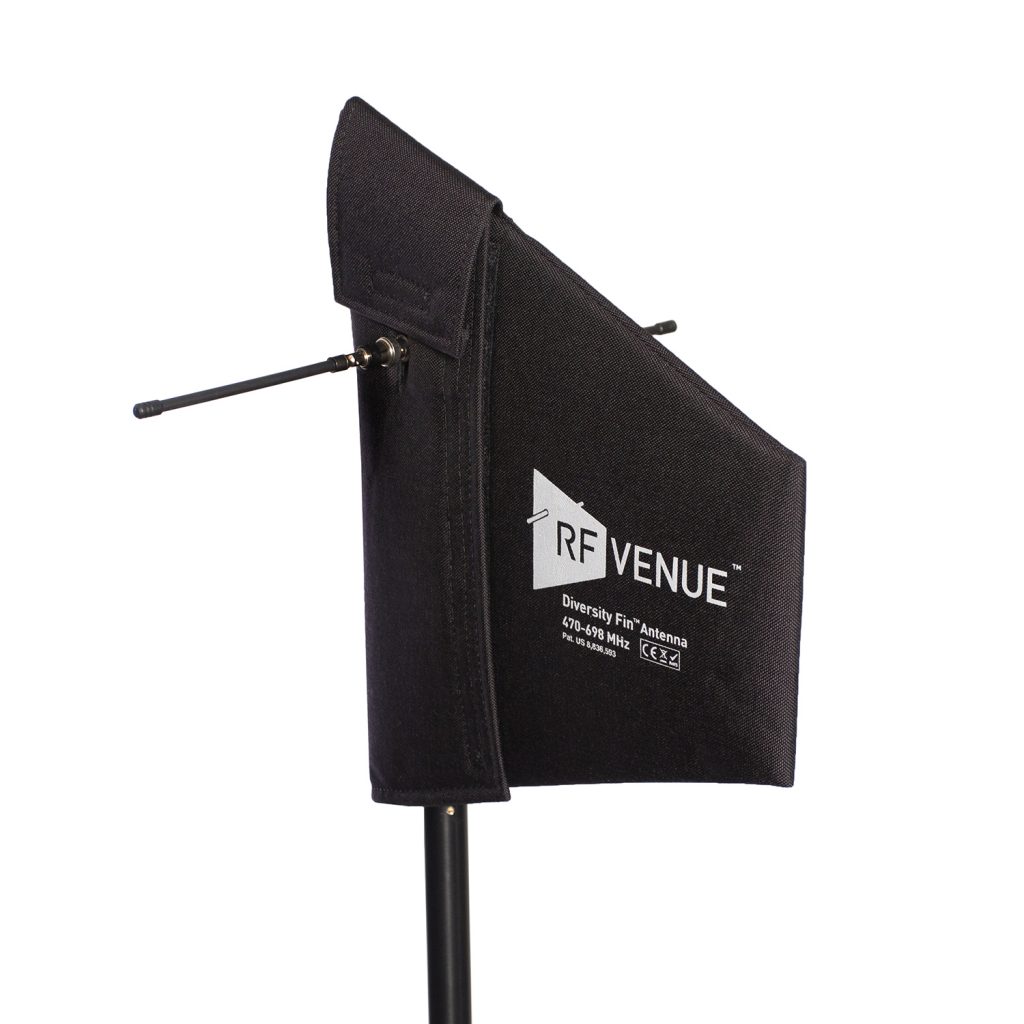
RF Venue Polarised Diversity Antenna
Polarised Diversity Antenna
Latency

Since all professional grade 2.4 GHz mics are digital, latency is a bit higher than UHF analogue. But the delays aren’t all that bad on digital microphones, and don’t really stand too far behind UHF digital microphones. In fact, Line6 has latency that beats some UHF digital mics. Latency on 2.4 is only an issue when shows are being recorded for broadcast, or a picky artist starts complaining about monitor delay.

IT Department Wrath

2.4 GHz is the same band that most WiFi devices use. You can’t always expect to waltz into a facility – especially a secure one – and power up a 2.4 GHz device without someone from the IT department hunting you down and telling you to put it away. WiFi in corporate and stadium settings is carefully calibrated and, usually, completely full. IT professionals have tools that let them know if something is interfering with their network.

Bottom Line

2.4 GHz microphones are a great choice for those who only need a few channels and want hassle free setup. For those who need lots of channels and ultra-low latency, top-tier UHF mics are still the best choice.

2.4 GHz audio fidelity from reputable manufacturers should be more than acceptable for most applications.

While they may provide additional long-term security over 600 MHz microphones – which will soon be illegal – they do not guarantee complete immunity from interference. A vast sea of other devices uses the 2.4 GHz band, and their numbers will only increase as the Internet of Things explodes.

Need a High Performance 2.4 GHz Antenna?

Inspired by the popular UHF CP Beam antenna, this lightweight, miniaturised helical antenna is built for maximum gain in the 2.4 GHz band. Painstakingly designed and tested in the RF Venue laboratory, it provides significant performance improvements over other non-audio 2.4 GHz directional antennas that are intended for networking devices.

HARMAN Professional Solutions, recently debuted the AMX Connectivity and Transport (CT) Series, a family of 4K switching and distribution kits that combine auto switching, scaling and distance transport into a single kit that includes both a transmitter and receiver.

Two models are available, including a presentation kit targeting simple presentation applications and a conferencing kit that adds USB 2.0 transport and switching for use in web conferencing environments.

The AMX CT Series kits deliver added value and flexibility to conferencing and presentation solutions by providing a single, simple to implement solution that offers switching and connectivity where you need it along with unified control of both the transmitter and receiver—all over a single category cable.

“With the continued proliferation of collaboration environments in corporate and education, our customers have been seeking a solution for video switching and transport in rooms with both installed and BYOD sources,” explains Paul Krizan, Corporate Solutions Manager at HARMAN Professional Solutions. “These new connectivity kits provide a solution that is easy to order, design, and implement.”

Two Presentation and Conferencing Models:

AMX Presentation Connectivity and Transport Kit (CTP-1301)
The Presentation Connectivity and Transport kit was designed to address the needs of simple presentation environments, including 4K switching at the table, transport over category cable and additional connectivity at the receiver for an AMX Acendo Core or a room PC at the receiver, as well as scaling and output to the display. The receiver has built-in scaling, allowing the display to receive content in its native resolution regardless of the source.

AMX Conferencing Connectivity and Transport Kit (CTC-1402)
The Conferencing Connectivity and Transport kit was created to target web conferencing solutions where cameras, microphones, and other USB devices are installed in the room. The solution combines multi-format 4K60 video switching, scaling and distance transport with USB 2.0 peripheral switching. This allows dynamic sharing of room USB peripherals such as an AMX Acendo Vibe between visiting laptops, etc., and permanently installed devices such as an Acendo Core or room PC. This ensures excellent sound and visuals for guests whether they are using installed equipment or bringing their own devices.

AMX CTC 4K60 HDBaseT Conferencing CT Kit
AMX CT 4K30 HDbaseT Presentation Kit

“We are very excited to introduce the new AMX CT Series to the market,” says Shaun Robinson, VP, Enterprise Solutions at HARMAN Professional Solutions. “Leveraging the economies of scale within the HARMAN supply chain, we are now able to deliver tremendous value to our customers by providing the latest in video switching technology at very competitive pricing. In addition, we are providing the best of both worlds: simple-to-install solutions with auto-switching and no programming required—but solutions that are also NetLinx Native for easy integration into a controlled application.”

Availability

JPRO has CTC and CTP stock to demo today. To learn more about the AMX CT Series contact JPRO today.

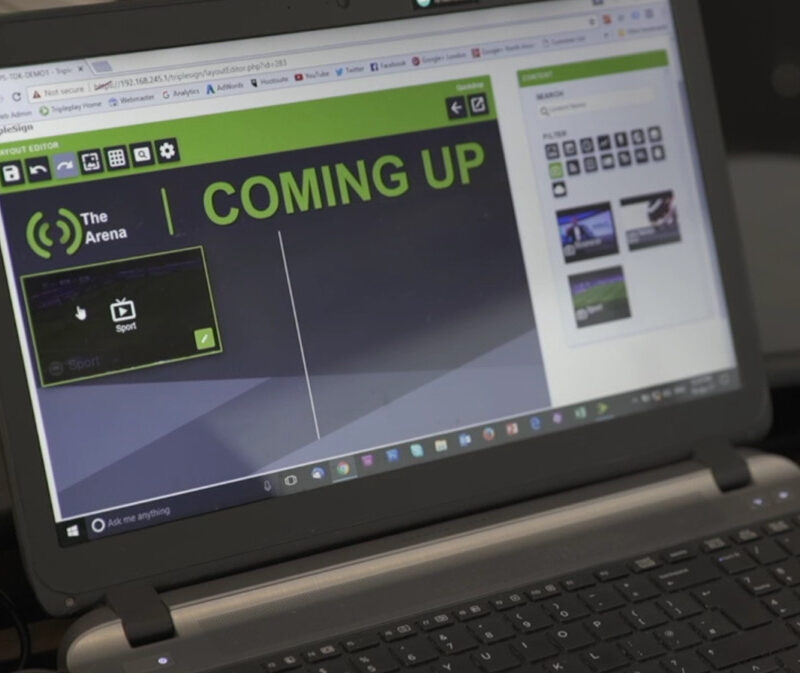
Leading Enterprise Video, IPTV and Digital Signage manufacturer, Tripleplay, has released its latest software platform, Caveman 3.0, bringing an unrivaled level of integration and unparalleled feature capabilities to the AV/IT market.

With 25 new features and improvements and enhancements across the platform, one of the platform’s most significant software releases to date. Tripleplay has continued to develop even more simple innovations, ensuring that our clients, both future and existing, have a reliable and future proof platform for enterprise video, IPTV and digital signage.

Feature Highlights:

  • 6-Way Multiview Video Streaming on a single endpoint
  • Social Media Plugin and display for Digital Signage
  • TripleView server monitoring for multiple site rollouts
  • Map View in TripleClient for easy viewing and controlling of endpoints
  • Multicast to Unicast video streaming support
  • Closed Caption Processing and Subtitle Upload for Videos
  • SAML Authentication for User Management pages
  • Optimisation of video playback, enabling quality integrated IPTV and digital signage delivery

Tripleplay CEO, Steve Rickless, commented on the release saying, “Tripleplay is always ambitious when it comes to software releases and I am extremely proud that, despite many engineers now working remotely, the team has been able to release all new features and enhancements as planned for Caveman 3.0.

“We continue to push the boundaries of our market, leading the way for other manufacturers in our industry and making sure we support and meet the needs of our growing customer-base.”

Tripleplay Easy to Use

Tripleplay’s Caveman 3.0 software release is available now through Tripleplay’s Authorised Partners and NZ Distributor JPRO.

For more information please download the Caveman 3.0 brochure here. Or contact our Tripleplay specialist Quentin White

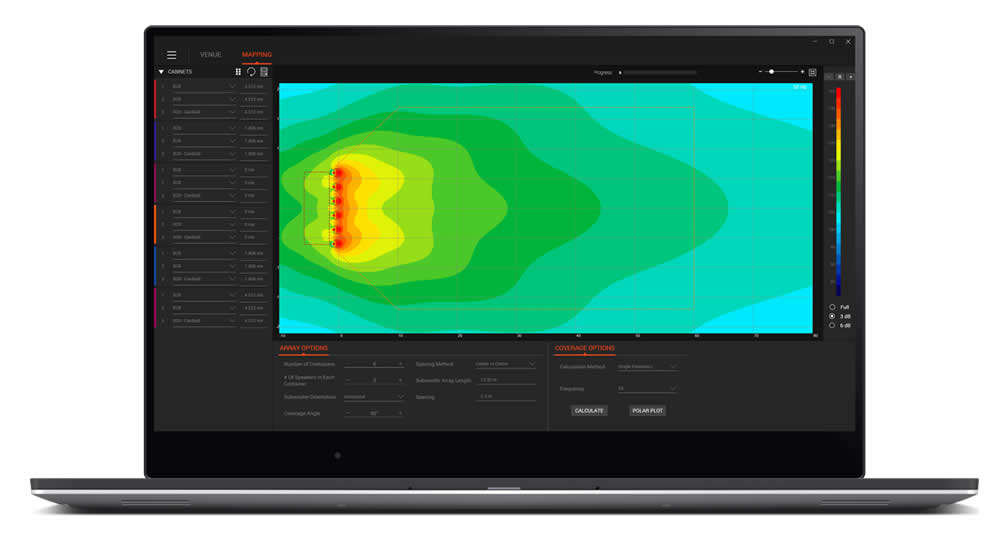
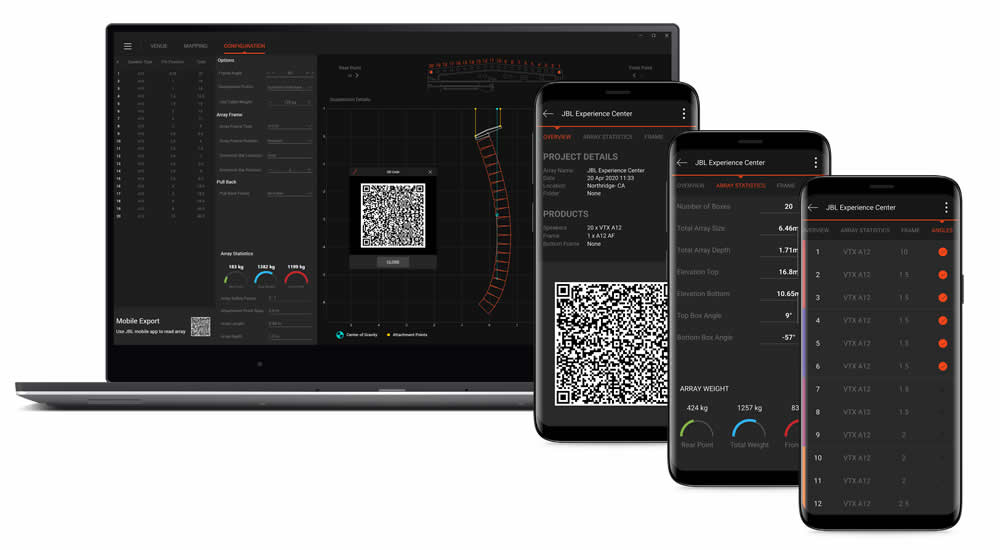
JBL Professional has released the latest version of Performance Manager v2.7.0. The update announcement includes updates for JBL Line Array Calculator (LAC) simulation software v3.5 and the JBL ArrayLink app v1.3 for Android and iOS.

It is recommended to update all software programs to maintain maximum compatibility.

JBL Performance Manager is the next-generation software application designed to configure networked audio systems for corporate and live concert events, as well as systems within performance venues such as theatres and houses of worship.

Highlights for the PM update include:
  • Better placement of tools for system setup
  • Improvements to GUI and zoom functionality
  • Simplified amp rack building and renaming
  • Sub delay values are now carried over and auto-updated when imported from LAC or adding new circuits
  • Group editing and ordering mode improved
  • LAC 3.5 includes the latest family of VTX loudspeakers and accessories, including the new JBL VTX B28 dual 18” subwoofer

Using Performance Manager dramatically reduces design time, simplifies networking and automates control interface configuration. The patented workflow paradigm of the Performance Manager interface guides the system designer through the complete system design, configuration and control process and, in many ways, the entire process feels and acts like a simple step-by-step wizard.

Networking has been reduced to a simple drag-and-drop operation, and all test, tuning and calibration control interfaces are embedded – no need to spend time designing control panels.

Integration with Rational Acoustics’ world-renowned Smaart® acoustic testing and measurement software provides audio technicians and engineers with unprecedented access to measurement information—all delivered over the network in one screen. A dedicated show mode provides all the monitoring and control needed to have a complete picture of how the system is performing in real time.

MAIN FEATURES:
  • Patented step-by-step design workflow
  • Modern look with faster performance
  • Included preset support for all JBL Tour Sound products
  • Time saving and accurate integration with JBL’s LAC-II and LAC-III software
  • Integration with Rational Acoustics Smaart platform
  • Preconfigured system templates for fast deployment
  • Multi-touch support on Windows 10 touch-capable devices
  • Built in array optimisation and tools
  • Built in system supervision and loudspeaker test tools
System Requirements
  • Supported Operating Systems:
  • 64-bit versions of Windows 7, Windows 8.1 or Windows 10
Minimum Performance Guidelines:
  • CPU: 64 bit dual core @ 2.0GHz or better
  • Memory: 4GB


Optimal Performance Guidelines:
  • CPU: 64 bit dual core @ 2.50 GHz or better
  • RAM: 8GB or more
  • OS: 64-bit Windows 7 or above
  • Storage: SSD
Performance Manager 2.7.0 supported devices:
  • JBL VTX A-Series: A12, A12W, A8, B18, B28 models
  • JBL VTX V-Series: V25-II, V20, S25, G28 and S28 models
  • JBL VTX F Series
  • JBL VTX M Series
  • JBL VRX900 Series
  • JBL powered VerTec Series [with DP-DA installed]
  • JBL passive VerTec Series
  • Crown I-Tech HD Series
  • Crown VRACK 12000
  • Crown VRACK 4x3500dbx
  • dbx DriveRack® 4800 / 4820

Please make use of the link below to download:

Soundcraft have announced the availability of the Ui24R firmware update v3.3.8293 effective from 1 June 2020.

Changes to the firmware include:
  • Performance improvements to web server stability
  • Performance improvements to WiFi frequency accuracy
  • Performance improvements to clocking stability, including clocking during Cascade operations

v3.3.8293 is approved for use on all Ui24R hardware.

It is recommended that all Soundcraft Ui24R users update their hardware for maximum performance.

As of the 2019 v3.0 firmware update, the Soundcraft Ui24R has been enhanced with Cascading and many significant new features.

Features as of the v3.0 firmware update:
  • Cascading: Double your inputs or double your mixes
  • Cue Recall: save mix settings as Cues and then quickly and seamlessly recall them
  • UDP Control Recall: for triggering lighting control snapshots
  • Lexicon Reverb PreDelay: easily set the time before first surface reflections and simulate desired acoustic environments
  • More than 25 new supported touch screens
  • And more…

Software update instructions and download link can be found clicking on the button below.

Noisegate were certainly impressed with the AKG LYRA USB Microphone and we’re sure you’ll be equally as impressed too.

The Gang at Noisegate get hands-on with the Ultra-HD Multi-Mode Condenser USB Microphone from AKG, known as LYRA.

AKG LYRA has ultra high definition audio capture, with a sample rate of 192kHz at 24 bit. Other features like USB-C connectivity make it ideally matched for newer computers, and there’s a USB-C to USB-A cable included for older machines.

LYRA is designed for ease of use and plug and play. One cable connects to your selected device and you’re good to record. LYRA is compatible with OSX, Windows, iOS and Android devices. There’s a registration card for Ableton Live Lite included too for those who don’t already have a favoured DAW on their computer.

Fast Facts:

  • 4K-compatible, Ultra HD-grade, 24-bit/192kHz audio resolution
  • Four-capsule mic array provides four user-friendly capture modes
  • Headphone monitoring with volume adjustment
  • Microphone mute and gain adjustment
  • Comes with Ableton Live 10 Lite
  • Industrial-Retro Design inspired by the C414
  • Versatile mounting option with integrated desktop stand or standard mic stand

Harman Professional Solutions has announced a licence free JBL Digital Directivity Analysis (DDA) 5.1 software update at ISE 2020.

Designed to work with JBL Intellivox products along with any point source speakers in the JBL portfolio using common loudspeaker format (CLF) data, DDA software is a powerful simulation tool for electro-acoustic design. DDA enables sound designers to visualise and statistically predict direct SPL, total SPL, D/R ratio, STI and delay spread.

Designed to offer improved workflow, the licence free 5.1 update adds two significant new features. DDA 5.1 streamlines the registration process and removes the need for repeated license renewal found in earlier versions of the software. DDA 5.1 also includes the new SketchUp plug-in, which enables users to easily import 3D geometry from SketchUp software.

Intellivox makes use of JBL’s advanced beam shaping (DDS) technologies. From DDA the radiation pattern of JBL Intellivox loudspeaker arrays can be controlled precisely and tailored to the shape and the acoustics of the space. In addition, DDA offers various design tools which reduce design time and help the sound designer to optimise the system performance. For installation and commissioning purposes DDA also generates FIR output filters which can be uploaded to supported DDS-controlled loudspeaker arrays using the JBL WinControl software.

“With DDA 5.1 we’re continuing our mission to help users streamline the modelling process to achieve more effective results with JBL loudspeakers,” comments Nat Hecht, product manager, commercial sound, Harman Professional Solutions.

“With DDA 5.1, users can instantly start using the program after registration. And with integrated support for third party software like SketchUp, engineers and acousticians are able to streamline their workflow.”

Overview of DDA Functionality:
  • 3D geometric models can be built in DDA using:
    • Built-in interactive 2D geometry builder
    • Import geometry from SketchUp requires Plug-in
    • Import geometry from Catt Acoustic, Odeon or EASE
  • DDA supports a wide variety of JBL Loudspeakers
    • All JBL Intellivox loudspeakers
    • All point source JBL loudspeakers described by a CLF file
  • DDA includes design tools such as:
    • Statistical room acoustic modelling including:
      • Direct SPL
      • Total SPL
      • D/R
      • STI
      • Delay Spread
    • Export of directivity data usage in Catt Acoustic, Odeon or EASE
    • Export/copy graphics to various formats

DDA 5.1 and the SketchUp Interface are available to download free of charge from the JBL website here.

Leading New Zealand professional AV distributor and AVC solutions company JPRO has been appointed as the official distributor for Tripleplay’s digital signage, IPTV and video streaming content delivery solutions in NZ.

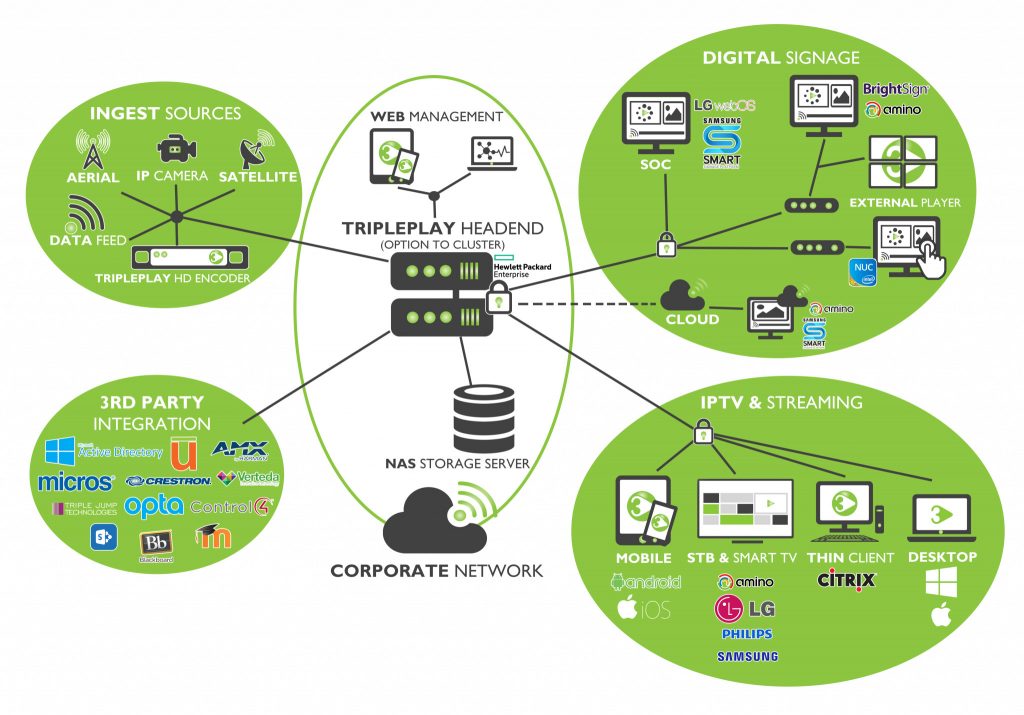
Tripleplay is an industry leader and specialises in the delivery of video and rich media content over a network to many devices, providing a user-friendly, centrally managed single platform solution for digital signage, IPTV and video streaming.

For more than 30 years JPRO has led the way in the New Zealand market, specialising in customising designs and providing audio and video system solutions for their dealer network. The appointment as Tripleplay distributor allows JPRO to provide digital content services and solutions that are complementary to its current product suite.

“As technologies advance and as JPRO as a company has advanced to become a leading audio, video and control specialist with world-renowned brands, technologies and customer-centric solutions, we are excited to add Tripleplay to our product portfolio,” says Bruce Gray, Managing Director at JPRO. “We believe that Tripleplay is suited to work alongside our products where we will be able to provide new opportunities with scalable, tailored digital content distribution in a number of markets.”

Steve Rickless CEO of Tripleplay commented on the new partnership saying, “We are very excited to have a local partner in JPRO who are well established in the AV industry across New Zealand and the Pacific Islands. We feel that the Tripleplay brand complements their current offering and allows us to offer an enhanced and compelling proposition to our clients and partners.”

Paul Edlin, JPRO Sales Director says “We look forward to this opportunity, we view Tripleplay as a leader in the IPTV digital communication space and see many opportunities in various markets. We look forward to a mutually beneficial partnership, providing exceptional service and support to Tripleplay partners and clients.”

JPRO’s reputation for exceptional customer service, design support and technical expertise is showcased in an array of projects encompassing education, hospitality, government, corporate and entertainment sectors throughout the country. JPRO has appointed sales and technical specialists that will provide on-the-ground support to help grow Tripleplay in New Zealand.

RF VENUE BLOG: In our experience, active antennas are misused and abused. Many people don’t fully understand what an active antenna actually does. They only know the word ‘active’ sounds better than ‘passive’ and that ‘more’ is better than ‘less’.

Hell, I know I do. But here’s the deal: active antennas can really do a number on your system if you aren’t using them right. This article should get you up to speed on the active vs. passive debate.

First, two definitions:

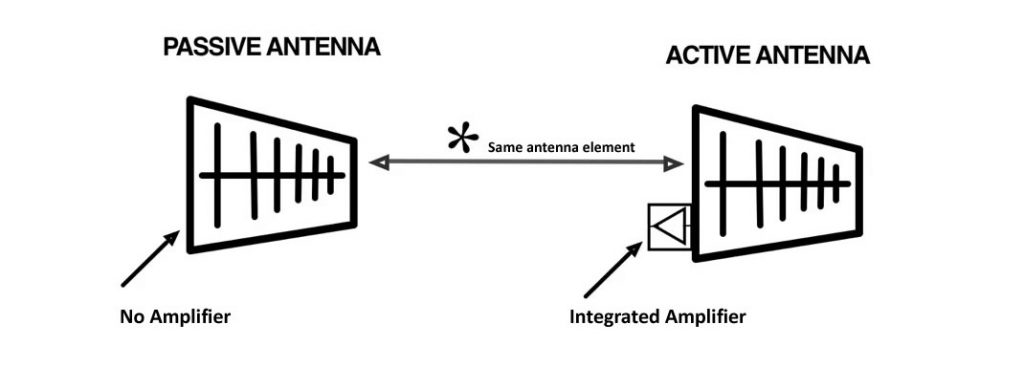
Active antennas are any antennas with integrated signal amplifiers built right into the unit, like the AKG RA4000B-W.

Passive antennas are antennas that have no amplification stages, like the CP Beam.

An active antenna is a passive antenna that simply includes an onboard amplifier. There is no difference between the antenna element of an active or passive antenna of the same type; the only difference is whether an amplifier is included.

Active antennas can be used for both receiving and transmitting applications, but they are most often seen as receiving antennas. When used to receive signal, the integrated amp boosts the RF picked up by the antenna and allows much longer remote cable runs.

When used as a transmitting antenna, active antennas increase the RF power above and beyond whatever output power the transmitting device is using.***

The only practical reason to use an active antenna is to compensate for cable loss in receive applications. All RF signal loses strength (attenuates) as it passes through coaxial cable. The longer the cable run, the larger the loss. 100’ of RG8X will steal anywhere from -8 to -11 dB, depending on a few factors, like frequency. The amps on active antennas are designed to compensate for this loss by boosting the signal right behind the antenna before sending it down the line, so the gain at the receiver is closer to unity gain.

It is important to note that active receive antennas do not increase directional gain. Which is another way of saying that the amplifier has no effect on the electrical characteristics of the antenna, and therefore no effect on an antenna’s fundamental ability to pick up RF energy floating through the air.

If you use active antennas on a coax run that is too short, you risk overloading the RF front end of the receiver system, which can manifest itself as catastrophic audio over your PA. Likewise, you can easily overload by using an active antenna’s gain control at a setting that is dis-proportionally strong for the cable run’s length.

UHF cable runs of less than 50 feet do not require active antennas or in-line amplification to compensate for loss. The loss is too small to make any audible difference, and without carefully calibrating gain structure you put the overall health of your audio ecosystem at risk. Also, keep in mind that if you’re using a directional antenna like the Diversity Fin or the CP Beam, you’re adding gain at the antenna (without an amplifier) which can make up for short run cable loss. [More on this topic, ERP, will be in a post next week. UPDATE: Here is that post.

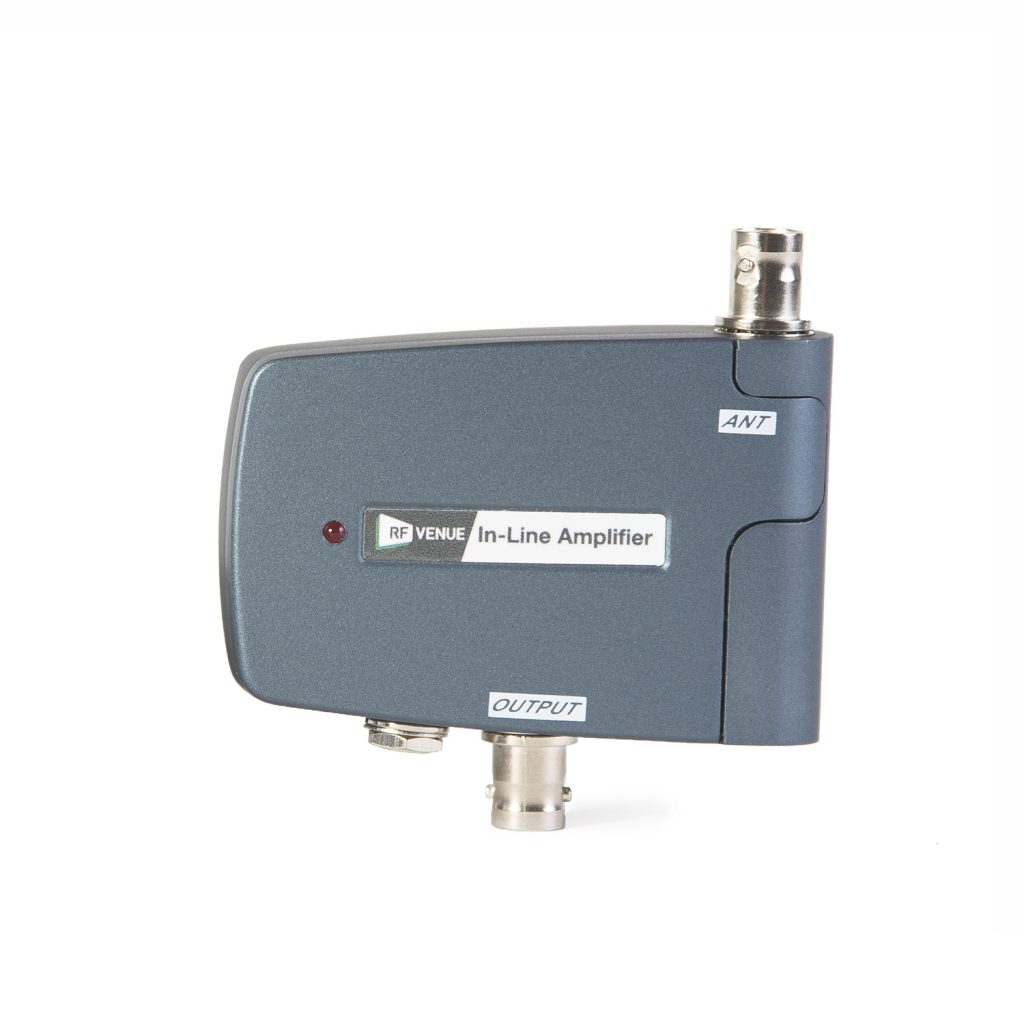
An independent in-line RF amplifier. Similar amps are included on active antennas.
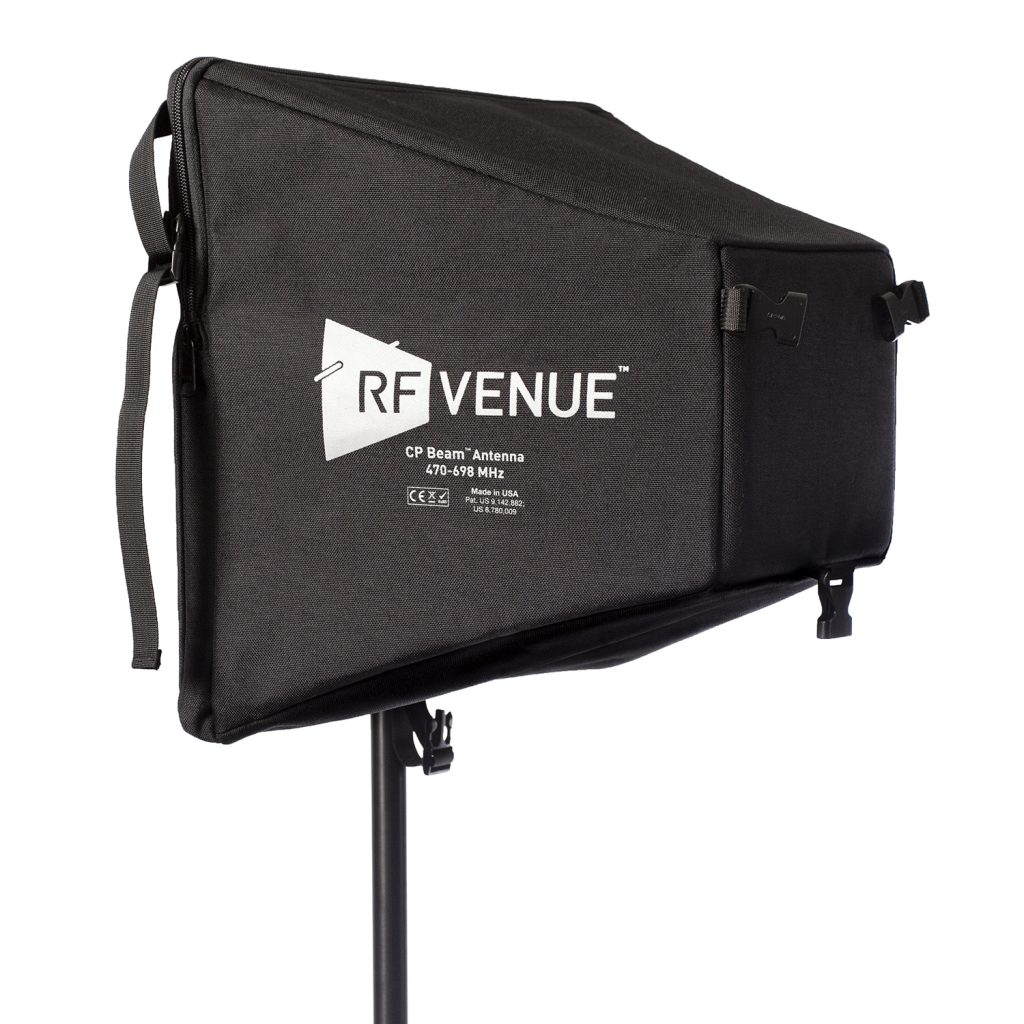
CP Beam Passive Helical Antenna

All too often, we’ll find a small theater or school or church system is using an active antenna at the side of a stage with a +12 dB amplifier on a 50’ or 25’ run. This gain is in addition to the + 6db of gain the paddle antenna itself imparts. With their transmitters at 30-50 mW, the front end of the wireless receiver gets overloaded and all hell breaks loose (except in a church, where hell is kept safely at bay).

We always encourage our customers to buy passive antennas, and then only add in-line amplifiers to make up for transmission line loss if they are doing very long cable runs of more than 100 feet.

With the introduction of low-cost RFoF technology, active antennas and in-line amplification are becoming increasingly obsolete. In the past, if an installed system required a cable run over 100’ there were only two options: use expensive plenum rated coax, or use some combination of active antennas/in-line amps and carefully manage the gain structure to avoid overload or coax line loss. With fiber optic transmission, signal can be sent miles with little to no loss at all.

***Use caution when deploying active antennas in transmit applications. In the VHF/UHF broadcast bands, most transmitters already operate at or near the maximum output power allowed by the FCC. Adding an amplification stage before the transmitting antenna risks exceeding those limits, so unlicensed UHF users should never include an active antenna in the signal chain of an IEM or intercom system. Plus, an active antenna’s amplifier would need to be bi-directional to function in a Tx setting. Not all of them use bidirectional amps.

Originally published by Alex Milne for RF Venue

Mike Russell believes that everyone should have access to great quality audio.

He runs Music Radio Creative, a leading audio provider and production company for radio, DJs and podcasters. Through his business and YouTube channel, Mike helps people create great sounding audio.

Mike recently took the JBL 104 Reference Desktop Speakers for a spin saying, “These monitors are fantastic… I can’t say enough good things. Really good quality for content creators!”

Watch the full review here:

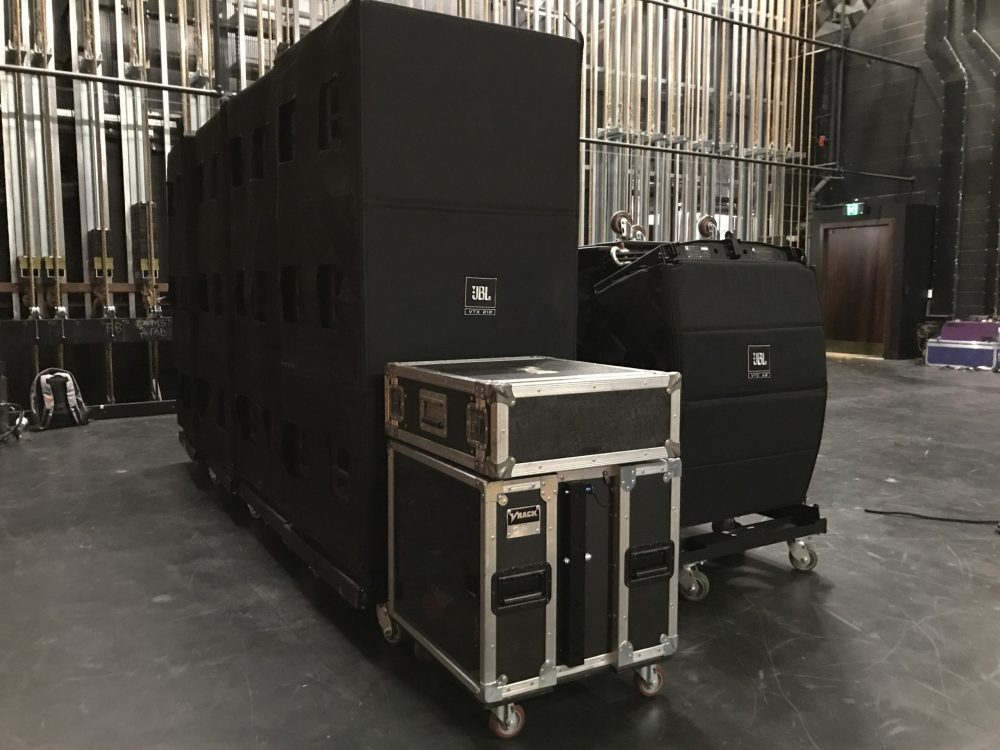
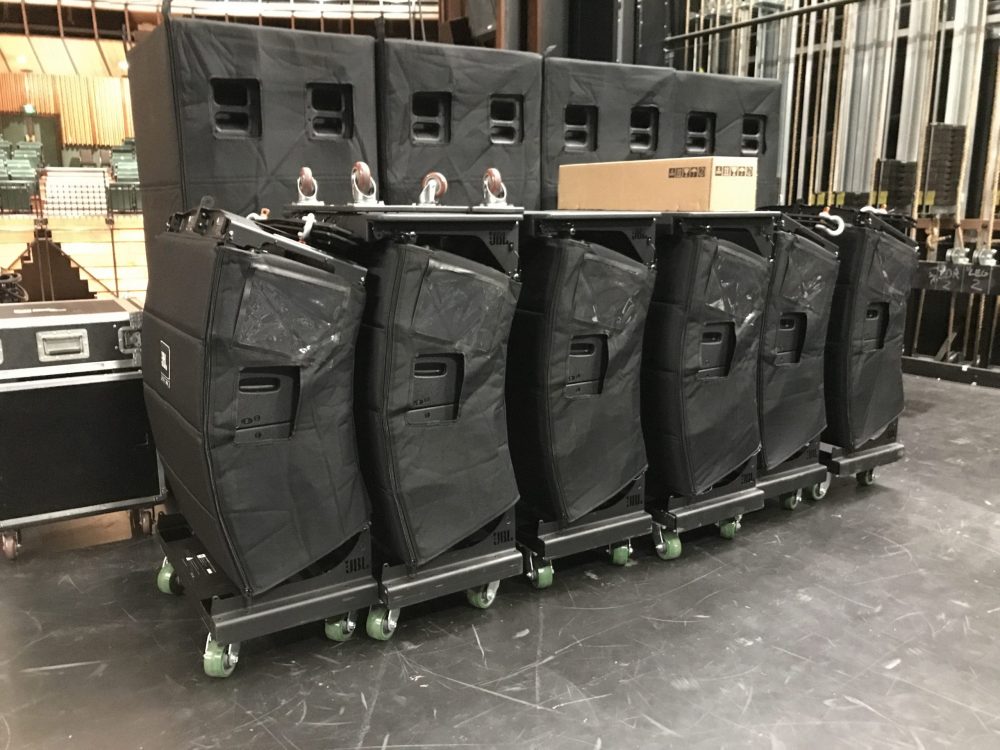
Production company Stage & Audio from Rockhampton Australia have joined the new JBL line array revolution and purchased a VTX A8 concert system, cementing their place as a leading supplier of top-end PA to Queensland’s touring and events market.

Stage & Audio’s owner Tim Buchholz first owned a pair of JBL K140s back in the 1970s and he was blown away by the A8’s high-end performance, courtesy of the A-Series’ revolutionary new drivers and waveguide. These designs are responsible for the A-Series redefining the ‘JBL Sound’ and winning over long-term JBL fans and sceptics alike. “I have never heard clarity like that or top end that accurate in all my years working in pro audio. The level of performance is ridiculous,” enthuses Tim. “I’ve simply never heard anything like it. It’s still JBL, but noticeably more ‘European’. It’s a totally new sound.”

19 elements of JBL A8 have joined Stage & Audio’s inventory. Crown iTech HD3500 power amplifiers have also been brought in to supplement their existing racks, and the rig has just been augmented by the recent acquisition of 12 x JBL B18 Subwoofers.

The A8s have already been out working hard in their first two weeks, covering a Queen tribute band, the Rockhampton River Festival across two stages, and an awards night. “After these jobs, all our in-house engineers and guest techs that have mixed on them can talk about is the high-end performance. It’s such a step up,” adds Tim.

It’s not just the sonic performance that offers a clear advantage for Stage & Audio; the industry-leading rigging, designed from the ground-up by JBL for the A-Series, makes getting the system in, up, and out again safe and fast for the whole crew.

“The rigging system works very well, especially when compared to its major competitors,” observes Tim. “It was as much the rigging as the sound that influenced our decision to purchase, which was confirmed for me making some changes to the system in our warehouse not long after I’d helped rig a competing product. Add to that the IP55 rating and it was a no-brainer. The fact that JBL is one of the only manufacturers that designs its own components is evident in the build quality and performance.”

“The number of amp channels required to run a VTX A8 system at high SPL is almost nothing. Our A8s are smaller, lighter, and easier to hang and transport than other systems, and we end up saving a lot of money on amps and power,” adds Aaron Buchholz, Head Technician, Sales and Installations, at Stage & Audio.

The A8 system joins a stable of JBL Professional products helping Stage & Audio run their day-to-day operations. These include fifty SRX712M 12″ stage monitors, twenty or so members of the EON family, and a range of powered PRX PA systems with subs and tops. More often than not, their passive boxes are powered by Crown amplifiers. A fleet of Soundcraft Ui tablet mixers provides quick and portable WiFi mixing for smaller gigs.

“Overall, the A8s have fantastic linearity,” concludes Tim. “There’s a newness to their sound, and you know every parameter and every frequency is being carefully watched over by advanced FIR filters, and compression and control algorithms. It creates and natural, sophisticated sound that is comparable to the best European touring systems on the market.”

Providing clarity and richness far above that of a laptop or computer that allows you to follow the conversation, JBL 104BT Desktop Speakers are studio reference quality and can be used for home office, remote learning, content creation and critical audio listening – as well as anyone looking for accurate, yet compact PC speakers on their desktop.

Available in a stylish matte white or matte black finish, JBL 104-BT and 104-BTW are reference quality. Combining legendary sound quality, class-leading performance and flexibility with the convenience of Bluetooth for many desktop applications.

JBL 104 BT Reference Desktop Speaker Set is suitable for both consumer and critical audio listening. It makes the essentials list as the finest sounding speaker set to have on your desktop for WFH, remote learning, multimedia content creation and even audiophile listening.

JBL 104 BT Desktop Speaker Set for WFH or Music and Content Creation Multimedia PC Speakers

Compact Powered Desktop Monitors

With JBL One Series reference monitors, we started with the mission to give content creators the ability to hear all the details for better results while mixing and editing. Drawing on seven decades of JBL Professional engineering, the One Series represents an innovative new set of speakers, designed from the ground up to provide the most accurate sonic presentation of any monitors in their class.

With the amazing sound that’s made JBL the top choice for recording studios, cinemas and live concert stages in compact, affordable, and stylish desktop speakers, the JBL 104 Powered Reference Monitors and 104-BT Powered Reference Monitors with Bluetooth are ideal for recording musicians, podcasters, and music and video producers— as well as anyone seeking enjoyable listening experience.

JBL 104 Pro reference desktop bookshelf speakers with bluetooth and multi input
INTEGRATED BLUETOOTH FUNCTIONALITY

Taking professional, compact reference monitors to the next level, One Series 104-BT (black) and 104-BTW (white) speakers feature Bluetooth 5.0 wireless audio streaming. With Bluetooth compatibility, gamers and content creators have the flexibility to reference their mixes through wireless or wired connections to ensure their tracks sound great on all listening devices.

Follow all the details of your hybrid WFH remote meeting with JBL 104 desktop speakers
PRO PERFORMANCE, SCALED TO SIZE

The world’s top recording studios and touring artists rely on JBL Professional monitors to deliver unparalleled fidelity and performance. Now, we’ve optimised that technology in our smallest form factor ever.

The One Series reference monitors’ innovative new coaxial driver design features a high-frequency driver aligned with a precisely contoured woofer cone to deliver accurate response, exceptional detail and impressive off-axis performance for the most neutral, accurate presentation, desktop to desktop, room to room. Plus, the cabinet’s precisely contoured low-frequency port works with the driver to provide accurate bass at all listening levels. And with low frequency extension down to 60 Hz, you’ll be impressed with the bass you get, even without a subwoofer.

Create your best content with JBL desktop reference 104-BT speaker monitors
LOUD AND CLEAR

JBL 104-BT reference desktop monitors offer premium performance, even at louder playback levels. This is accomplished through clean, integrated 60-watt Class D amplification that distributes 30 watts per speaker.

And with their efficient design, One Series speakers can be driven to 104db SPL (peak), without the distortion found in other monitors in their class.

NZ's favourite work from home remote learning productive PC desktop speaker set JBL 104-bt
STREAMLINE YOUR SESSIONS

JBL One Series reference desktop monitors were created with the modern production lifestyle in mind. They not only feature a sleek, new look for JBL, but with their compact size, content creators can get legendary JBL sound even in smaller workspaces.

Smart features like a front-panel volume control allows convenient level adjustments without straying from the sweet spot, the front-panel headphone jack automatically mutes the speakers, providing isolation in one simple step, and dual 1/4-inch balanced and single 1/8-inch unbalanced TRS inputs (plus Bluetooth on the 104-BT AND 104-BTW) accommodate a wide range of sources. In addition, 104-BT and 104-BTW include a front panel selector that allows you to easily switch between inputs or keep them all active.

FEATURES
  • Master and extension speaker sold as a set
  • Coaxial 4.5-inch (118 mm) LF driver and .75-inch (19 mm) soft-dome HF driver deliver full-range fidelity
  • Reference quality for mixes, with built-in Bluetooth 5.0 streaming
  • Integrated 60-watt Class D power amplifier
  • Acoustically optimised for desktop placement
  • Patented low-frequency port for deep bass extension down to 60Hz
  • Three sets of inputs allow connection with professional equipment, computers, personal music players and consumer-level devices
  • Front-panel input control selects Bluetooth, Aux, RCA, TRS or combines all inputs
  • Front-panel volume control
  • Front-panel headphone jack with speaker mute function
  • Available in stylish matte white (104-BTW) and matte black (104-BT)

JBL 104 Product Videos:

Products:

JBL 104-BT reference bookshelf desktop PC speakers for Zoom Teams Audiophiles

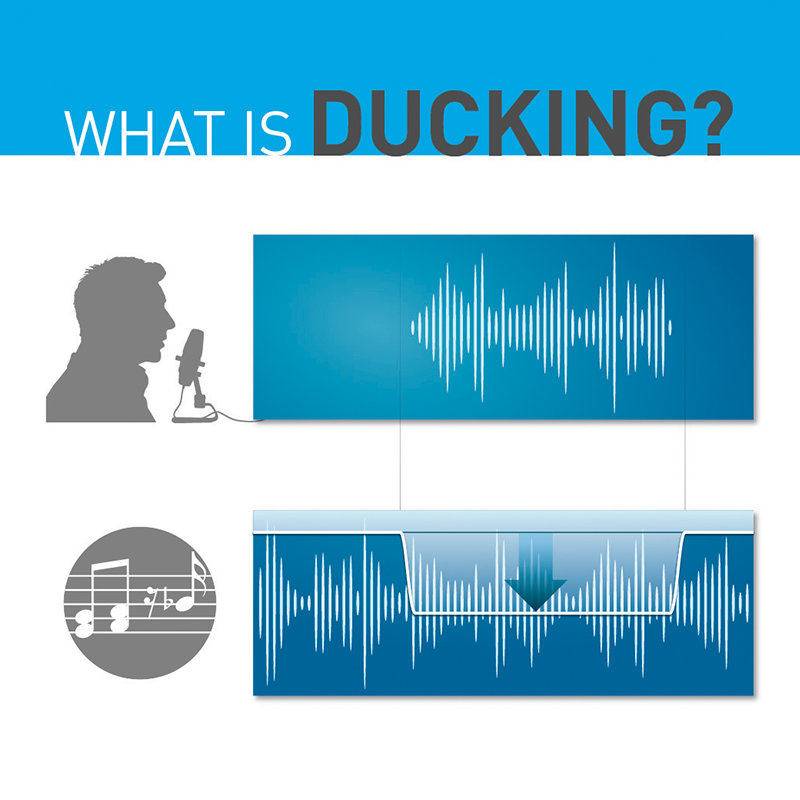
Ever been at an event and noticed that when the emcee starts speaking, the background music instantly drops, then it pops right back up again as soon as that person finishes talking? This isn’t some frenzied mixing engineer frantically pushing faders up and down; this is audio ducking in action.

Ducking temporarily lowers, or “ducks,” the volume level of a specified audio signal anytime a second specified audio signal is present. In live sound, ducking is commonly used to lower background music anytime a person speaks, then raise it when that person finishes speaking, as in the emcee example above. This technique can be employed in any scenario where you need to be heard over backing tracks, whether you’re hosting an event, giving a speech or teaching a fitness class.

How does it work?

So, how does ducking work? Let’s get technical for a minute: Ducking is an application of sidechain compression, in which the output level of one sound channel controls the action of a compressor effect on another channel. Here, a control channel is set to trigger a compressor on a correlated channel or channels whenever the control signal exceeds a predefined volume threshold. When the control channel exceeds the threshold, the compressor kicks in and the level of the background channel is reduced; when the control level drops back below the threshold, the background channel level comes back up to its normal level.

Ducking chains can be created manually with signal processors, or for automatic, foolproof results, take advantage of the one-touch ducking feature built into JBL IRX and EON family portable P.A.s and select Soundcraft mixers including the Notepad series and the Ui24R. It’s a powerful function that takes the guesswork out of configuring signal chains and lets you keep your focus where it belongs—on your performance.

Audio Ducking Infographic
Top Waveform: An audio “control” signal dictates the volume level of the ducked audio signal. The control signal remains at full volume at all times. Bottom Waveform: The “ducked” audio signal level automatically lowers anytime the control signal is detected or reaches a predefined volume threshold.

Ducking isn’t limited to live sound; in the studio, ducking is used when recording narrations, voiceovers, translations, podcasts, YouTube videos, and other productions that benefit from lowering background music under speech. It’s even used (or more accurately, misused) creatively in EDM and pop music production to trigger volume “pumping” and other special effects. (Great examples of pumping include Eric Prydz’ “Call on Me” and Daft Punk’s “One More Time.”) A ducker can also be inserted in a reverb or delay line to manipulate those effects.

Whether you’re performing live or in the studio, ducking is a fast and easy way to manage audio levels, make room for all of the elements in your mix and ensure your voice is always heard, loud and clear.

HARMAN Professional have announced that warranties for all Crown Products have been extended to six years for items purchased between 1/1/20–12/31/20

Artists, producers, sound engineers and systems integrators rely on Crown amplifiers to deliver clean, stable power every day. We stand by the quality and workmanship of our award-winning products and back them with some of the best warranties in the business.

Now, we’re making the deal even sweeter: For a limited time, when customers purchase any Crown product, we’ll extend their warranty to six years—for free. That’s a one-year extension on five-year warranties, a three-year extension on three-year warranties, and an incredible five-year extension on our one-year warranties.

We think your customers will be thrilled to learn that they can now enjoy unprecedented power, performance—and even greater peace of mind.

Offer valid for new products purchased January 1, 2020 through December 31, 2020. Not valid in Brazil, Russia, India or China.

We are pleased to announce that as a leading professional audio distribution and AVC solutions company, JPRO has been appointed by HARMAN Professional Solutions as the AMX video control solutions and SVSI Networked AV solutions distributor for New Zealand.

JPRO has a long and successful history of association with HARMAN, representing professional audio brands JBL, BSS, Crown, Soundcraft among others for more than 30 years in New Zealand. The company’s rich history has resulted in a reputation for exceptional customer service, design support and technical expertise which is showcased in a myriad of projects throughout the country.

“JPRO’s 30-year history with Harman Professional has been cemented further with the announcement today,” says Bruce Gray, JPRO owner and director. “We are all honoured and thrilled to be adding AMX, a brand with its own rich history, superior quality and leading-edge products, to our current suite of Harman Professional Audio brands.”

JPRO operates a highly successful AVC training program, with a nationwide network of system integrators and resellers providing on-the-ground localised support. With the expansion of its portfolio to include the complete range of AMX video control solutions and SVSI Networked AV solutions, the company will appoint specialists that will provide the best technical expertise and solutions in the New Zealand market.

Paul Edlin, JPRO Sales Director adds “Our Team is looking forward to the opportunity of taking the full Harman AVC suite of products to market and showcase the exceptional experiences this can offer. New Zealand’s System Integrators and Consultants are at the forefront of innovation in the AVC market and therefore to fully support them we will be expanding our team to drive this new venture. The right staff are crucial to the continuity of service and support that our customers expect from JPRO.”

“We are excited to expand our partnership with JPRO and extend our distribution reach in New Zealand.This is aimed at enhancing access to HARMAN products and solutions across verticals, focusing on solutions-driven approach and elevating customer experience,” said Ramesh Jayaraman, VP and GM, HARMAN Professional Solutions, APAC. “JPRO brings 30 years of experience serving the New Zealand market and we look forward to our expanded collaboration with JPRO and are confident their experience and in-depth knowledge will help us deliver the latest and most relevant technology solutions to our customers.”

Support, warranty and repair of AMX and SVSI products in New Zealand will transition to JPRO with immediate effect. Warranty terms and inclusions will not be affected.

The first dedicated JBL branded cinema amplifiers offer high power output, cutting-edge DSP and versatile networking options with Dante/AES67 and ATMOS compatibility.

JBL Professional have announced new JBL DSi 2.0 Series cinema amplifiers, offering class-leading power output, state-of-the-art DSP and advanced networking capabilities for the entire range of JBL cinema loudspeakers

The DSi 2.0 amplifier family, JBL’s first line of dedicated cinema amplifiers, builds on Crown’s DSI Digital Screen Array amplifier technology and integrates best-in-class CDi DriveCore DSP to deliver potent, cost-effective amplification and audio networking capabilities for JBL’s entire range of cinema loudspeakers. Choose from three power configurations, available in analogue and analogue-plus-digital “D” versions featuring Dante/AES67 connectivity. The “D” models allow direct and simple interface with Dolby ATMOS Connect and AES67 / Dante compatible devices without the need for additional processors.

“As cinema audio systems continue to grow larger and more complex with 5.1, 7.1 and immersive audio formats, venue owners require more efficient ways of powering, controlling and managing networked audio systems,” said Karam Kaul, Vice President of Audio, HARMAN Professional Solutions. “The JBL DSi 2.0 Series combines cutting-edge technology from Crown DSi and CDi Series amps with a new high-output design for superior sound quality. Cinema managers and integrators looking to maximize their power investment and future-proof their systems can count on the DSi 2.0 Series to deliver robust, reliable performance in a compact and cost-efficient package.”

DSi 2.0 Series amplifiers provide four channels of clean, efficient amplification with bridgeable outputs in a compact 2RU footprint, and are efficiently PowerMatched for JBL Cinema loudspeakers to deliver greater power density in the same rack space. DSi 2.0 Series amps can power up to four JBL surround speakers with a single channel in high-power-density 2Ω mode, which both speeds deployment and makes DSi 2.0 a cost-efficient solution since less amps are required to power a cinema audio system.

With class-leading 96 kHz/32-bit floating-point DSP, DSi 2.0 Series amplifiers offer an array of versatile signal processors, including parametric EQ, FIR processing, LevelMAX™ limiting and more. Crown’s proprietary DriveCore technology eliminates hundreds of components within each DSi Series amplifier, reducing the variability of component values to deliver greater efficiency, reliability and performance. Built-in presets for JBL cinema speaker tunings manage voltage levels, crossover settings and more, maximising system efficiency and optimising audio fidelity.

Analogue-plus-digital DSi 2.0 Series amplifiers offer AES67 connectivity, which enables networked audio distribution from any AES67 or DANTE-compatible device and direct interfacing with Dolby ATMOS Connect without the need for additional processing hardware, further simplifying system configuration while also presenting significant cost efficiencies.

Dual network audio ports allow for primary and secondary networks configured as switched (daisy chain) or redundant (star) topologies. Analogue-plus-digital DSi 2.0 Series amps also feature SNMP (Simple Network Management Protocol) connectivity for interfacing with third-party theatre-management systems and Cinema Control (NOC) systems for remote status and fault monitoring. A HiQnet port provides access to HARMAN Audio Architect software, for controlling, configuring and monitoring amplifier operation through a standard TCP/IQ network.

JBL DSi 2.0 Series Cinema Amplifiers complements the range of JBL Professional cinema solutions available including the new JBL CPi2000 Cinema Processor and JBL 200 Series Compact Cinema Loudspeakers.

Models

The DSi 2.0 Series consists of six amplifier models, ideal for cinemas, theatres and premium large-format rooms.

  • DSI2-LA4: 1,200 Watts at 8 Ohms
  • DSI2-LA4-D: 1,200 Watts at 8 Ohms, Dante/AES67, Dolby ATMOS Compatible
  • DSI2-MA4: 700 Watts at 8 Ohms
  • DSI2-MA4-D: 700 Watts at 8 Ohms, Dante/AES67, Dolby ATMOS Compatible
  • DSI2-SA4: 350 Watts at 8 Ohms
  • DSI2-SA4-D: 350 Watts at 8 Ohms, Dante/AES67, Dolby ATMOS Compatible

All models are optimised for 4 ohm and 2 ohm loads both in stereo and bridged modes.

Availability

JBL Professional Cinema products are supported and distributed in NZ by JPRO.

JBL DSi 2.0 Series cinema amplifiers are now available through special order. Should you require any assistance and design support regarding your cinema project, please make use of the contact button below.

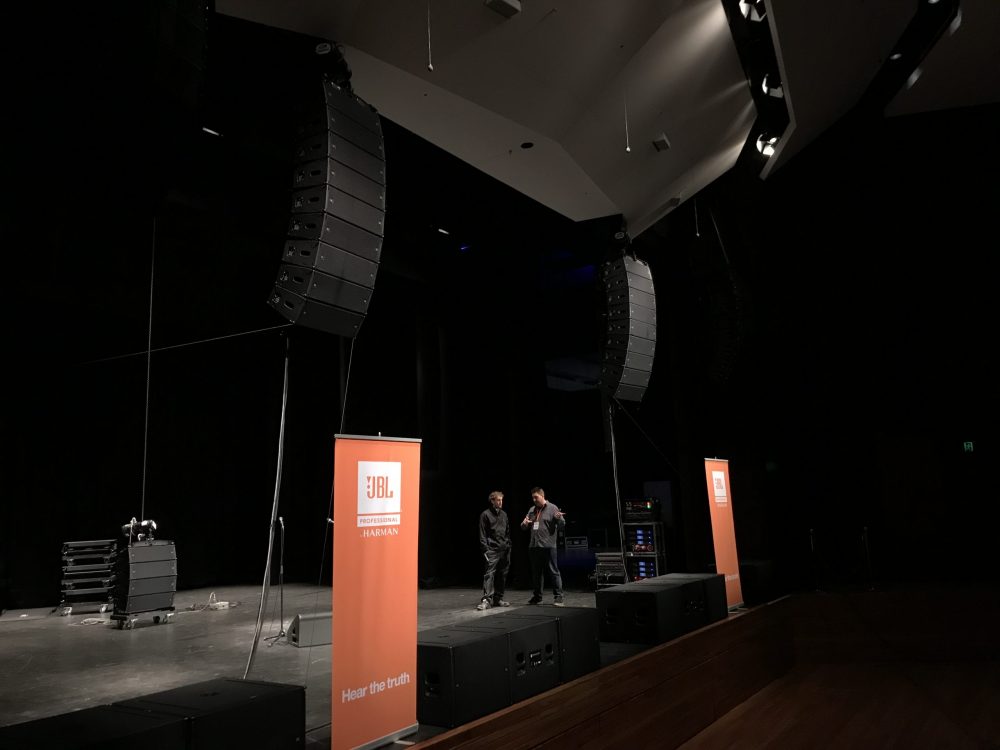
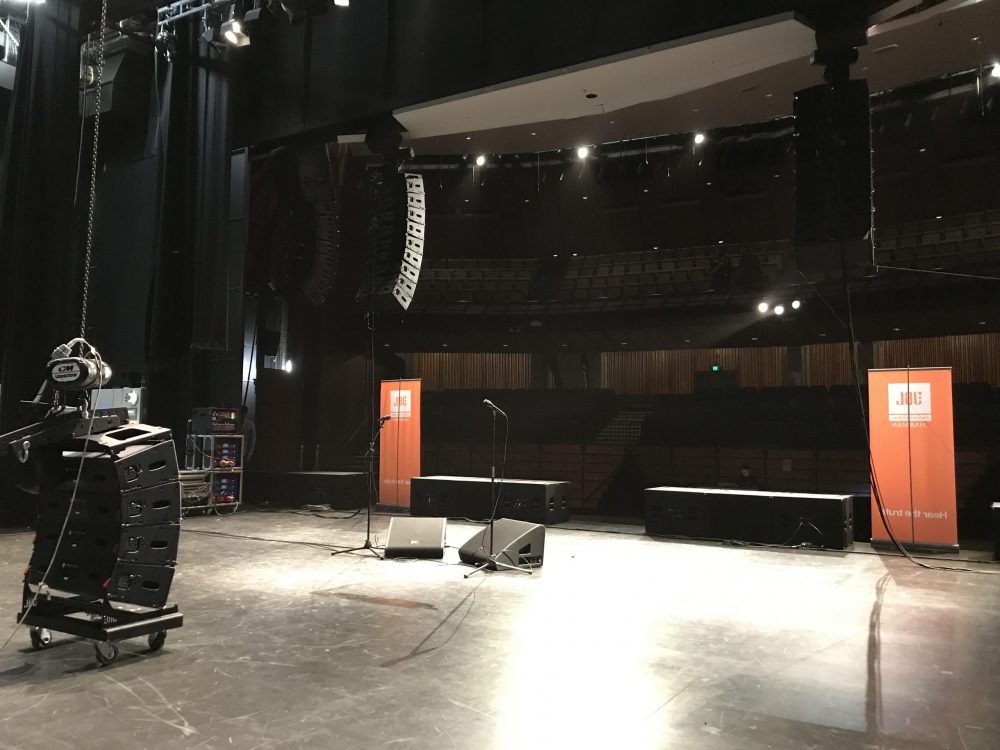
JPRO recently presented an exclusive demo of the JBL VTX A8 to a select group of entertainment and commercial industry representatives in Christchurch.

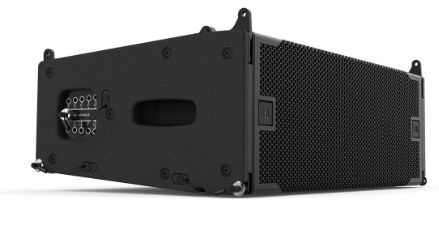
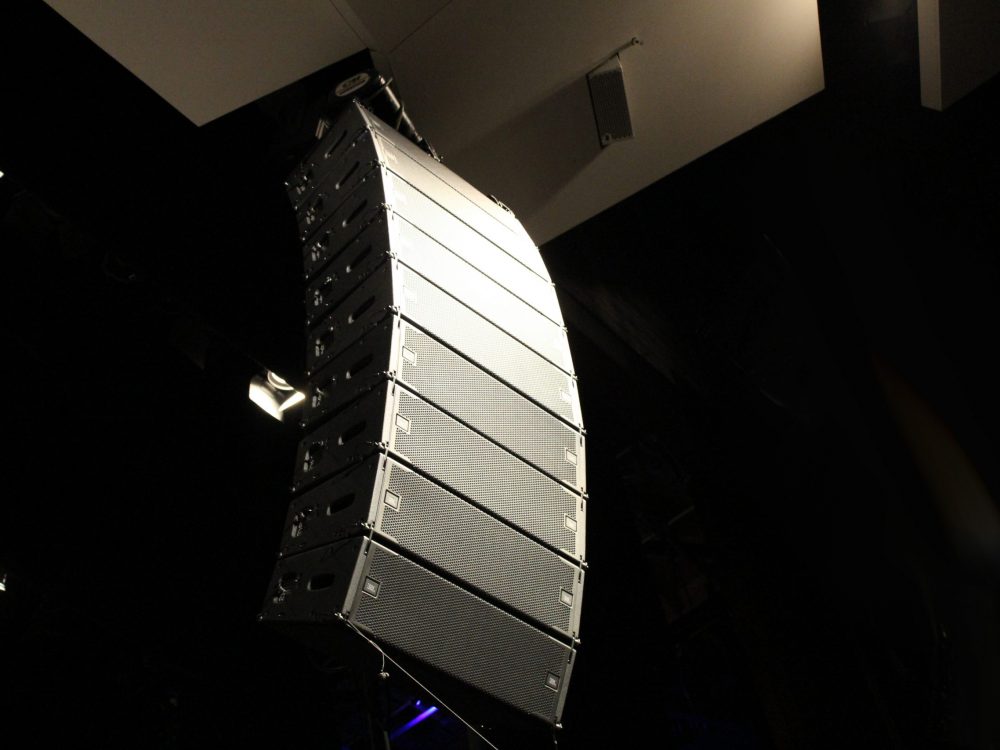
The VTX A8 is a compact line array system available in installed and tour formats for small to medium sized venues. VTX A8 and its bigger brother VTX A12 have impressed this year during NZ’s Summer Festivals – being used extensively with touring artists and music festivals such as Toto, UB40, Slayer, KORA, Sound Splash and The Hollies.

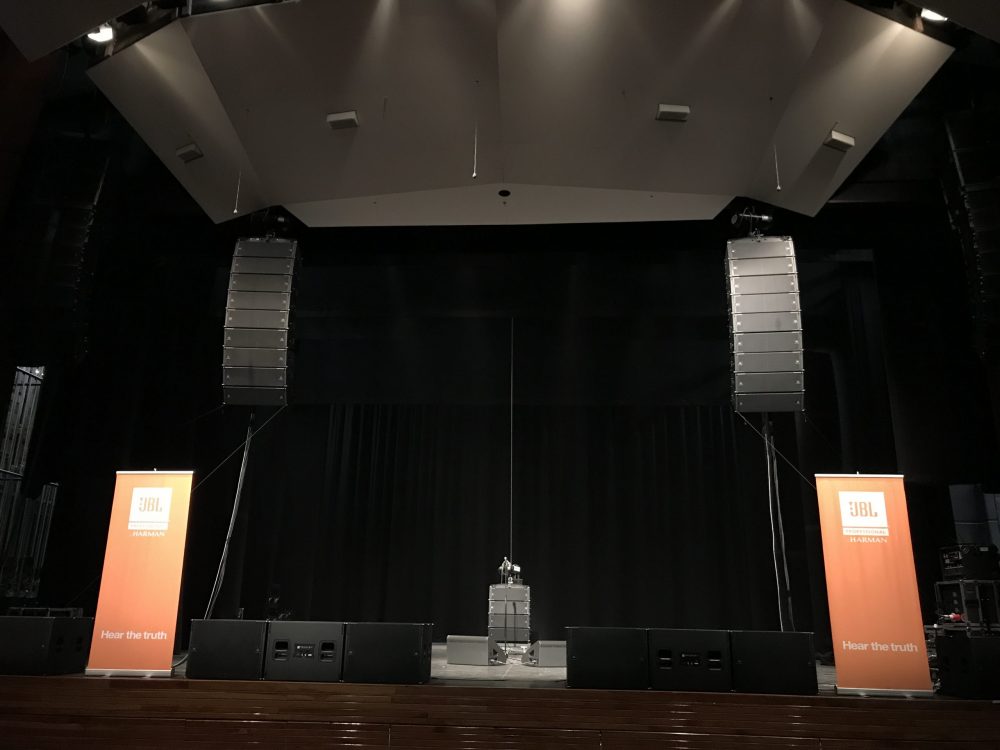
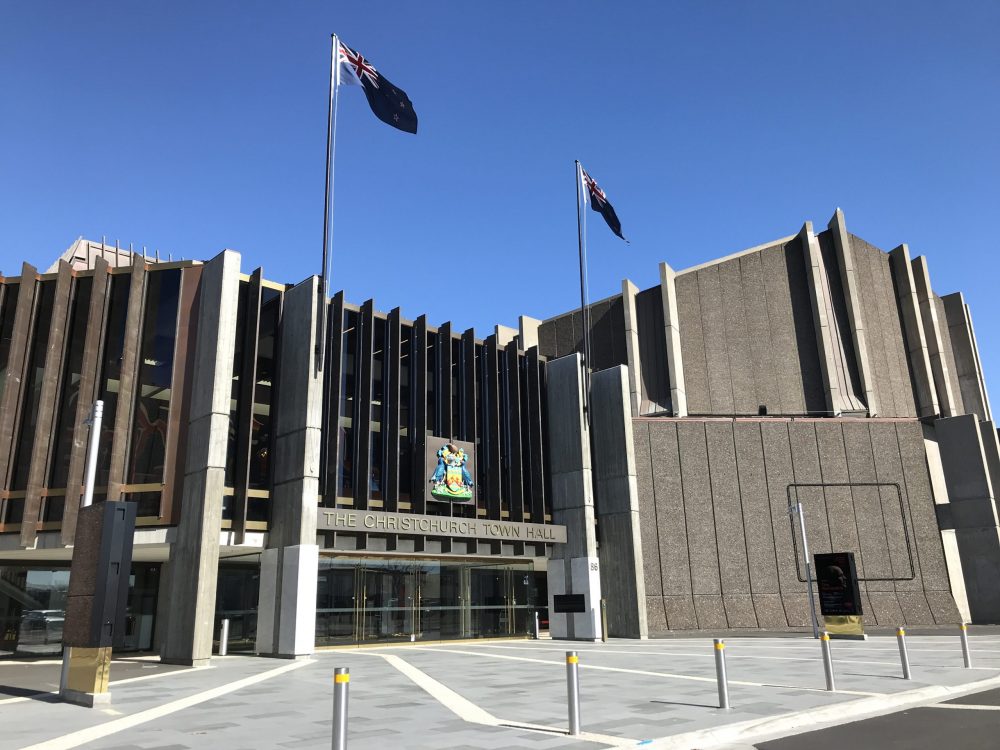
The demo took place at the newly rebuilt Christchurch Town Hall in the exquisite James Hay Theatre.

“It’s fantastic that we are able to use venues such as the James Hay Theatre to allow audiences to get a first-hand impression of the JBL VTX A8,” comments JPRO’s Tour Sound Manager Tim Robertson. “This is a new sound from JBL and it is important for people to experience the transparent, smooth sound for themselves. I enjoyed watching everyone’s response when the system is run in full range – we had jaws dropping when we told our guests that we were not running the subs.”

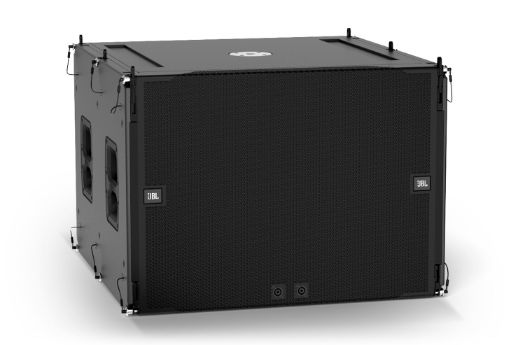
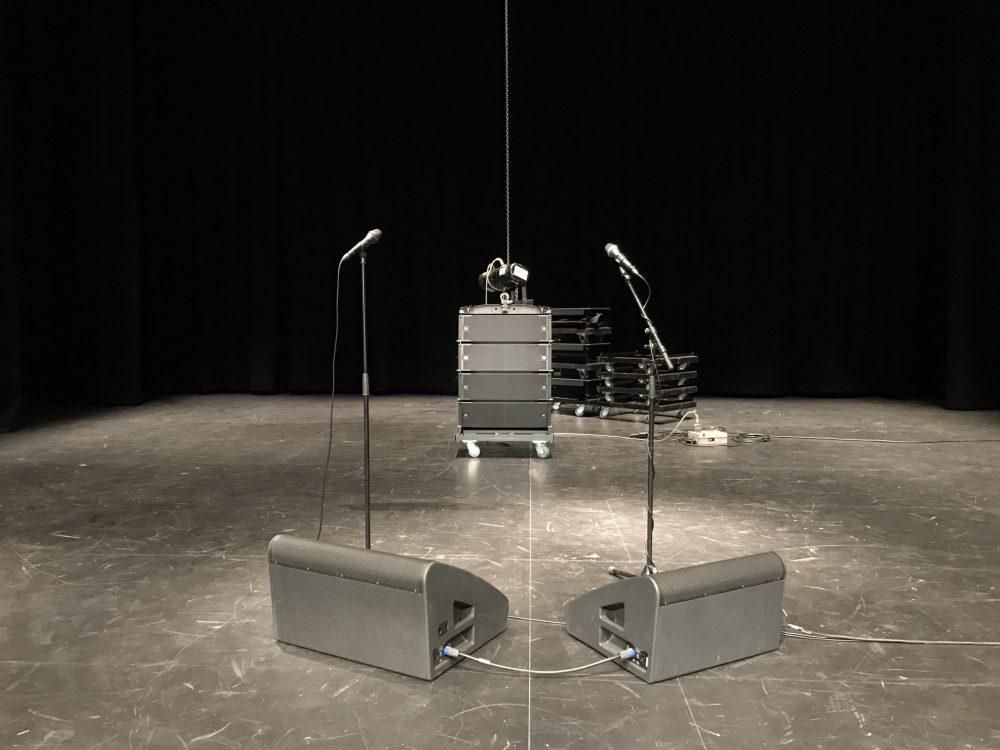
After a full range demo, JBL’s new generation of subwoofers, VTX B18 were used in 90 degree sub-array configuration, while the VTX M Series touring wedges were demonstrated on stage. The cardioid subwoofer configuration cancels out sub-bass spill on the stage, allowing for a quieter stage for performances.

Due to a tight schedule the crew were able to provide a fast setup – with final system checks ready to go in less than 90 minutes. “This is thanks to the VTX A-series newly devised world-leading rigging system, travel carts and packaging system, which allows crews to be far more efficient for transport, set up and pack down,” says Tim Robertson, Tour Sound Manager at JPRO. “The ease of use and information flow between system calculation and deployment is effortless. We have received comments stating that the rigging and system configuration is the best available. A special mention to our crews who did a marvellous job getting everything together.”

Following the success of the demo at James Hay and in Auckland, by popular demand a JBL VTX workshop and A8 demo is being planned for Wellington later in the year.

Image: JBL VTX A8
Image: JBL VTX A8
JBL VTX B18 subwoofer
Image: JBL VTX B18 subwoofer

“The response at James Hay from the industry has truly been overwhelming and we would like to thank everyone for attending,” says Andrew Sorrill, Customer Support and Marketing at JPRO. “We would like to get as many industry professionals in New Zealand as possible to experience the system for themselves. If you have not recently heard the new JBL VTX A Series, I encourage you to get in front of a system – please contact us and we will arrange for you to hear one.”

Leading New Zealand professional audio distribution and AVC solutions company JPRO is an authorised Dante Domain Manager Reseller.

Dante Domain Manager (DDM) from Audinate brings IT best practices to the AV industry, making audio networking more secure, more scalable and more controllable than ever before.

“Venues that are using portable mixing consoles and other devices between rooms and plugging in and out of their Dante AV network are at risk of crashing their entire Dante infrastructure,” states JPRO’s Technical Manager. “The same applies to Dante sites such as churches and corporate environments that have guests using media and AV connections. We are pleased that we can bring added value to our customers and peace of mind that their audio network is secure and run according to IT best practices.”

Dante Domain Manager provides system managers complete visibility and accountability through a suite of user-defined dashboards, audit trails, alerts, and messages. This allows protection of AV routing and prevents other settings from being changed by unauthorised users.

This complete network management peace of mind includes:
  • Secure Encrypted Administration and Device Configuration
  • User authentication and control
  • Role administration
  • System status dashboard
  • Integration with Active Directory
  • Time-stamped audit reports of all changes

DDM enables user authentication, role-based security, and seamless expansion of Dante systems over any network infrastructure.

AV_Network_Dante_DDM Follow IT best practice with your Dante network using Audinate DDM with JPRO authorised NZ reseller and solutions provider
DDM Product Packages

Dante Domain Manager will be sold as a perpetual license and will be available in three editions: Silver, Gold, and Platinum. All editions enable the creation of Dante domains to isolate and organise audio devices, permission-driven user accounts, cross-subnet routing of audio, and powerful administrative features to monitor user actions and system status in key areas.

  • SILVER: An ideal solution for smaller installations such as houses of worship, recording studios and broadcast facilities.
  • GOLD: Perfect for medium-sized installations, including schools, small businesses, and larger houses of worship as part of a comprehensive AV management strategy.
  • PLATINUM: Designed for organisations with many users, rooms and devices in multiple buildings spread over large areas. This is Dante management for the largest mission-critical systems found in government facilities, universities, stadiums, public spaces and corporate offices.

If you require guidance on how to best manage your Dante setup through a secure managed audio network, we are here to help. Please contact JPRO for assistance with your Dante solution.

Dante Domain Manager Overview

Dante Domain Manager – Benefits for Integrators

We are excited to announce that JANDS NZ has introduced a new brand identity and rebranded to JPRO.

“One thing that’s constant in the vibrant audio visual industry is change,” says company Managing Director Bruce Gray. “We are proud of our heritage. For 30 years JANDS NZ has led the way in New Zealand, supporting musicians, businesses and institutions with their commercial and professional audio requirements. We have stayed on top of the changes as new products and platforms arrive in the market, grown and evolved with the times.”

“Now we’re embarking on another change, as we leave behind JANDS NZ – in name only – and introduce JPRO.”

The initiative has been prompted through the recent changes which sees JANDS Australia entering the New Zealand market.

“We have seen this as an opportunity to promote our own New Zealand brand in a new and revitalising manner. JPRO will resonate with our market and at the same time avoid any confusion with JANDS Australia. We remain committed to distributing HARMAN Professional Solutions, while adding other brands and look forward to growing our vast inventory of audio and video products.”

“These are exciting times in the industry and JPRO is building on an impressive track record,” comments JPRO Sales Director Paul Edlin. “Our reputation remains. Support of our integrator and dealer networks, which has been a key to our success, will continue, as will our nationwide audio training courses.”

The change took place on June 1st 2018 and included a brand refresh to reflect not only the industry but the attributes, history, values and essence of the company.

We look forward to contributing to your future success as we embark on this exciting journey.

Product by Series
Brands
Product by Category
Installed Audio
Installed Video
Portable Audio
Studio / Broadcast